💬 Deep Dive
Looking back at the sleep data recorded by Apple Watch in the past two years, I found that my deep sleep was not much, the average time was 50 minutes, accounting for between 10% and 12%, which is not a good data.
The direct impact of lack of deep sleep is that even if you sleep for 8 hours, you will not feel refreshed. In order to have a higher sleep quality and increase the time and proportion of deep sleep, I recently read “Why We Sleep” this book.
The following are my reading notes, which I share with you to help you sleep better.
1. Two Factors That Affect Sleep
Author Matthew Walker lists 12 healthy sleep suggestions at the end of the book. However, if you can only remember one of the 12 suggestions, it would be:
Stick to a regular sleep schedule. Go to bed at the same time and wake up at the same time every day.
For people with free time, such as freelancers, doing this is not simple, but it is much easier once you understand the two main factors that affect falling asleep and waking up - circadian rhythm and adenosine pressure.
Circadian Rhythm
Circadian rhythm, the body’s own biological clock. Our body’s circadian rhythm is not a standard 24 hours, but a little longer than 24 hours, so it is always easier to go to bed later than to go to bed early. If you want to have a regular schedule, you need to calibrate it with “timing factors” such as light, diet, and exercise.
In order to maintain the consistency of bedtime, you can adjust it through various timing factors such as sunlight, diet, exercise, etc.
Fixed daily times for eating, working, and exercising are all effective timing factors that help the body form habits. The most important of these is lighting. In the Sleep Toolkit shared by Huberman, the first item is: go outside to bask in the sun within 30-60 minutes after getting up in the morning, and again in the evening before sunset. Because sunlight stimulates the retina and regulates melatonin secretion, thereby controlling wakefulness and drowsiness.
Strong light in the morning suppresses melatonin, keeping people awake; light in the evening gradually weakens, promoting melatonin secretion and causing drowsiness.
Adenosine stress
Adenosine, a neurotransmitter, begins to accumulate in the body in the early morning and reaches its peak at night (12h-16h after waking up). It binds to neuron receptors and promotes drowsiness. After 8 hours of sleep, adenosine is cleared and accumulation begins again, and the cycle continues.
Caffeine wakes you up because it occupies adenosine receptors and temporarily suppresses sleepiness. But after caffeine is metabolized, adenosine will quickly bind to the receptors, causing a stronger feeling of fatigue.
Adenosine and circadian rhythms work together to influence sleep onset, but they are independent. You may have experienced waking up more and more as you stay up late, because no matter how much adenosine is accumulated, the circadian rhythm still cycles according to its own rhythm and will not stop because you lack sleep.
If you can understand and utilize these two mechanisms, it will be easier to develop regular sleep habits.
2. Sleep cycle and function
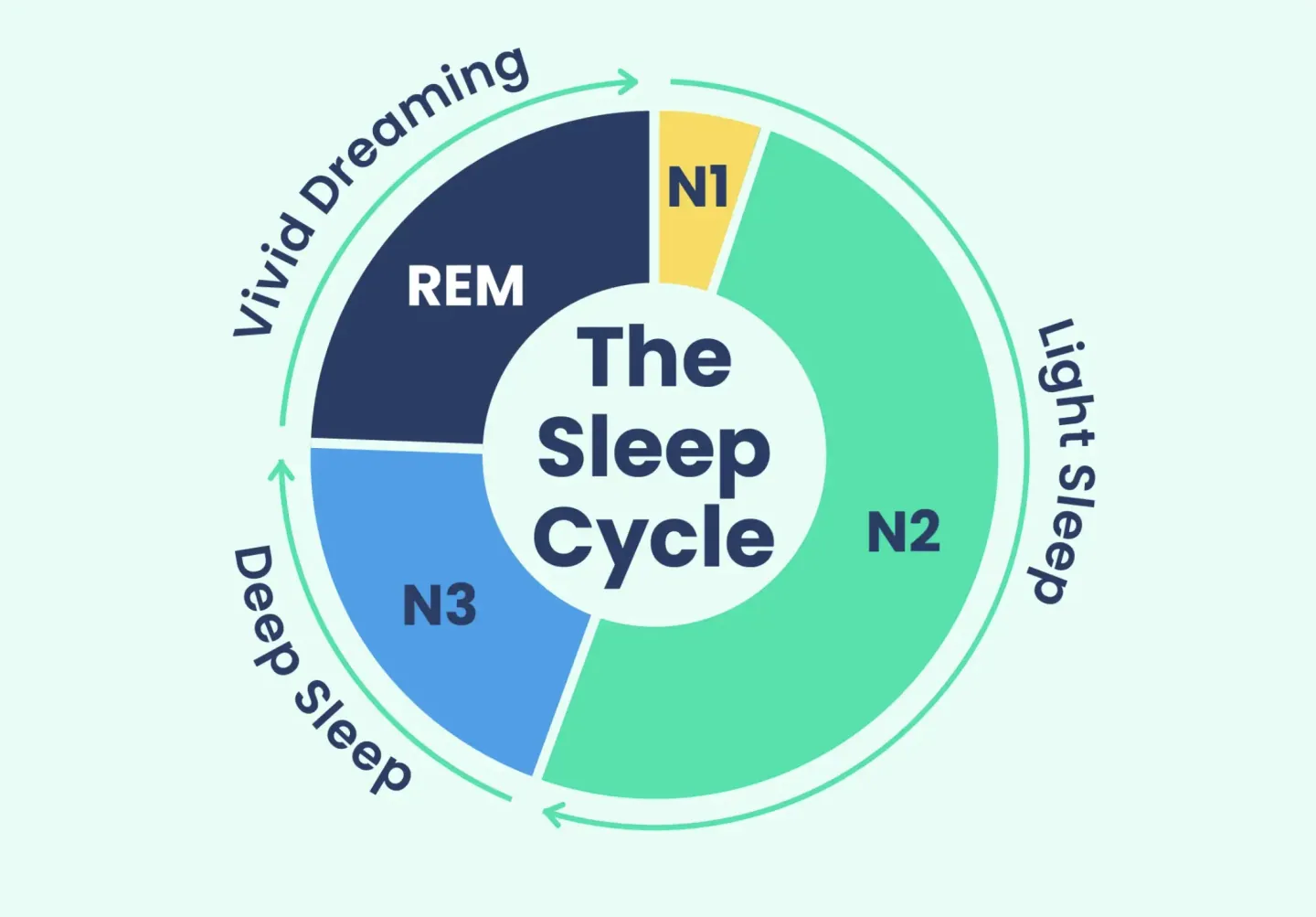
After falling asleep, our brains go through 4-5 sleep cycles each night, each cycle is approximately 90 minutes long. During each cycle, two completely different sleep patterns alternate:
- Non-rapid eye movement sleep (NREM)
- Rapid eye movement sleep (REM)
Non-rapid eye movement sleep (NREM)
Non-rapid eye movement sleep (NREM) usually occurs in the first half of the night and is divided into 3 stages:
- N1, accounting for about 5%-10%, is the transition period from waking up to falling asleep, lasting a few minutes, the body begins to relax and the heart rate slows down.
- N2, accounting for about 45%-55%, light sleep, brain waves slow down, body temperature drops, helping to enter deeper sleep. During this stage, “sleep spindles” will appear, which can not only transmit factual memories from the hippocampus (temporary storage) to the cortex (long-term storage), but also consolidate motor skill memories, such as musical instrument learning, sports, surgery, etc.
- N3, accounting for 15%-25%, is the deep sleep stage, also known as diffuse sleep, which is the part I am missing. The body will carry out important repair work during this stage, including the release of growth hormone, cell regeneration, strengthening of the immune system, and removal of toxic proteins that cause Alzheimer’s disease. At the same time, the memory transported from the hippocampus to the cortex in the N2 stage will be deepened and consolidated.
Therefore, the more deep non-rapid eye movement sleep, the more information you can remember the next day. Even a 20-minute nap during the day can bring memory consolidation benefits as long as you include enough non-rapid eye movement sleep.
Rapid eye movement sleep (REM)
Rapid eye movement sleep (REM) occurs concentratedly in the second half of the night, accounting for about 20%-25%. At this stage, the brain activity is close to the waking state, the eyeballs move rapidly, but the muscle tension decreases, which is the main period of dreaming.
“Ghost on the bed” happens at this stage. Your brain is awake, but your limbs are completely unable to move. Nature’s restriction of muscle activity in dreams is actually a kind of protection for our human bodies to prevent us from turning the fictitious movements in dreams into reality.
As mentioned earlier, in terms of information processing, non-rapid eye movement sleep (NREM) stores and strengthens new factual memories and transfers information from the hippocampus to the cortex. Rapid eye movement sleep (REM) collides, integrates, and connects these raw materials in the cortex with all past experiences. It associates and brings together different knowledge in a way that the waking brain will never try to form a very remarkable problem-solving ability. It can be said that rapid eye movement sleep (REM) allows us to turn knowledge into wisdom and be more creative.
REM sleep is also very helpful for emotional regulation. During this stage, the brain temporarily stops releasing norepinephrine (a neurotransmitter related to stress response), helping us to desensitize us from stressful and difficult states during the day, and even traumatic emotional events. As a result, we can remember and basically recall important life events without having such strong negative emotions.
However, the book believes that only people who have actually experienced traumatic scenes in their dreams are more likely to recover from trauma. If it does not appear in the dream, the negative emotion may last longer.
Sleep is not a simple rest, but an active repair and upgrade process for the brain and body. Different stages have their own division of labor, and none of them can be missing.
3. Sleep hygiene tool kit
So what should we do to sleep better? Here are 12 healthy sleep tips from author Matthew Walker:
- Stick to a regular sleep schedule. Go to bed at the same time and wake up at the same time every day. As creatures of habit, humans have difficulty adapting to changes in sleep patterns. Waiting until the weekend to catch up on sleep won’t fully make up for the lack of sleep during the week and can make it difficult to wake up on Monday morning. Alarms can be set for bedtime. We usually only set alarms for wake-up time, but not for bed time. If you can only remember one piece of advice from these 12, remember this one.
- Exercise is beneficial, but not too late in the day. Try to exercise for at least 30 minutes each day, but end your workout 2 to 3 hours before bed.
- Avoid caffeine and nicotine. Coffee, cola, some teas and chocolate all contain the stimulant caffeine, the effects of which may take up to 8 hours to wear off. So drinking a cup of coffee in the late afternoon can make it harder for you to fall asleep at night. Nicotine is also a stimulant and often causes smokers to fall asleep very lightly. Additionally, ex-smokers often wake up prematurely in the morning due to nicotine withdrawal.
- Avoid alcoholic beverages before going to bed. Having a glass of wine or an alcoholic beverage before bed can help you relax, but consuming large amounts of alcohol can cause you to lose REM sleep and put you in a lighter stage of sleep. Consuming large amounts of alcohol may also cause breathing problems at night. You may also wake up in the middle of the night as the effects of alcohol wear off.
- Avoid heavy meals and drinks late at night. Simple snacks are fine, but eating large amounts can cause indigestion and disrupt sleep. Drinking too many fluids at night can cause you to wake up frequently to go to the bathroom.
- Try to avoid medications that delay or disrupt sleep. Some common heart, blood pressure, or asthma medications, as well as some over-the-counter and herbal remedies for coughs, colds, or allergies, can disrupt sleep patterns. If you have trouble sleeping, talk to your health care provider or pharmacist to see if you take any medications that cause insomnia and ask if they can be taken at a different time during the day or night.
- Don’t take a nap after 3pm. Napping can help make up for lost sleep, but taking a nap in the afternoon may make it harder to fall asleep at night.
- Relax before bed. Don’t overschedule your day so much that you don’t have time to relax. Your bedtime routine should include a relaxing activity such as reading or listening to music.
- Take a hot bath before bed. The drop in body temperature may make you feel sleepy after a bath, but a bath can also help you relax and relieve tension, making it easier for you to fall asleep.
- Keep the bedroom dark and cool, and do not place any electronic products. Get rid of anything in your bedroom that might distract you, such as noise, bright lights, an uncomfortable bed, or a room temperature that’s too high. You’ll sleep better if the temperature in the room is kept cooler. A TV, cell phone, or computer in your bedroom may distract you from falling asleep. Having a comfortable mattress and pillow can help promote a good night’s sleep. People who suffer from insomnia often look at the clock, so turn the clock face out of sight so you don’t worry about the time while trying to fall asleep.
- Get some sunshine. Daylight is key to regulating daily sleep patterns. Try to spend more than 30 minutes in natural sunlight every day. If possible, wake up to sunlight in the morning, or use very bright lights. Sleep experts recommend that if you have sleep problems, you should get an hour of sunlight in the morning and dim indoor lights before bed.
- Don’t lie in bed while awake. If you’re still awake after 20 minutes in bed, or if you start to feel anxious or worried, get up and do some relaxing activities until you feel sleepy. Anxiety about not being able to fall asleep can make it harder for you to fall asleep.
Final
We spend a third of our lives sleeping, and sleep is as important to us as water and air, but we humans may be the only species that deprives ourselves of sleep.
The downsides of sleep deprivation are numerous, from increasing the risk of cancer, diabetes, Alzheimer’s disease and cardiovascular disease to weakening concentration, emotional stability and the immune system. Moreover, this loss cannot be fully compensated by supplementary sleep.
Getting a good night’s sleep is probably the most underrated way to heal yourself.
💎 Curated Gems
1. How to take notes
An old article by Nat Eliason on how to take notes.
The core idea of smart note-taking is that simply extracting key points is usually a waste of time. The key point will inspire you when taking notes, but if you don’t capture the inspiration it brings you, you’ll be less likely to remember its importance later. Even if you feel some inspiration while revisiting key points, you may have a very different interpretation.
When reading, don’t highlight the key points, but highlight sentences that make you think and inspire you.
When writing down your ideas, include context.
When organizing these notes and ideas, organize them according to their future destination, rather than classifying them according to their origin.
2. The Ultimate Online Writing Guide
I recently met a new friend, Daniel, through writing, and he recommended this David Perell’s Ultimate Writing Guide to me, which is very comprehensive.
Not only sharing how to find ideas to write about and how to write good content, but also how to promote content and build influence on social media.
Two quotes that I particularly like about building your own audience are:
Just because you get attention doesn’t mean you have an audience. Audience is not the number of people who know your name, but the number of people you can contact at any time (this is why traditional stars lack audiences even if they are famous). Some people also have much better audiences than others. **A large number of followers does not necessarily lead to loyalty. **
The value of an audience is that it takes time to build. If the audience accumulates quickly, it will not be able to form a sustainable advantage. You can buy attention, but you can’t buy trust. Trust has to be earned, and that’s what makes it so valuable.
3. What do you think of novels with moral flaws?
I listened to several episodes of Jiang Fangzhou’s podcast this week, and influenced by her and “One Sentence is Worth Ten Thousand Sentences”, I also watched the first season of Netflix’s version of “One Hundred Years of Solitude”.
At the end of this podcast “Why do adult men always fall in love with young girls in Marquez’s novels?”, Jiang Fangzhou shared her views on morally flawed novels, which was very inspiring to me.
She believed that there were only two kinds of novels, good novels and bad novels.
Good novels should expand the boundaries of our consciousness, allowing us to have a clearer judgment about what is beauty, what is good, and what is true, and can better help us understand this complex world and replicated human nature.
Bad novels narrow our values, flatten our worldview, solidify our prejudices, and make us lose our understanding of the complex world.
🧵 One More Thing
During the Dragon Boat Festival holiday, the plug-in TransPlace was finally put on the Chrome Web Store. This is a plug-in that supports inputting text in the input box (dialog box), pressing the shortcut key, one-click translation, and replacing the original text with the translated text.
The opportunity for making this plug-in is that to deal with product usage problems for Russian users, it is always necessary to use ChatGPT to translate Chinese into Russian, and then copy it into the dialog box and send it. So I thought about whether I could make a plug-in. In the dialog box, first write Chinese, then press the shortcut key to translate it into Russian and send it directly.
After having this idea, I shared it with a friend, and he told me that immersive translation also has this function. I tried it out and found that the experience was also very good, but it still couldn’t meet my needs, because immersive translation only supports specified translation into one target language.
Russian is not my only target translation language. I also need to translate English on a daily basis, so it took more than two months to slowly turn idea into a plug-in and release it, supporting the setting of 3 target languages.

This is my first plug-in product. It has reached a record for me, and I am quite happy. But from a product perspective, I am still not very confident and have not done any promotion.
Especially in the past two days, I saw that the computer version of the WeChat input method has also been updated. It has launched a “translate while writing” function, which supports translation into more than a dozen languages. As a system-level entry, the input method has much wider coverage than plug-ins. The product manager of WeChat Input Method has done a great job in catching the demand, and it’s an advantage again.